EA vs PA Career Progression: Which Role Grows Faster?
If you’re working as a PA and thinking about your next move, the key question is simple: which role offers better long-term growth?
Understanding EA vs PA career progression helps you make a clear decision. Both roles can lead to strong careers, but the speed, salary ceiling, and opportunities differ.
In this guide, you’ll see:
- How each role progresses
- Where salaries peak
- What skills unlock promotions
- The fastest route from PA to EA
PA Career Progression Path
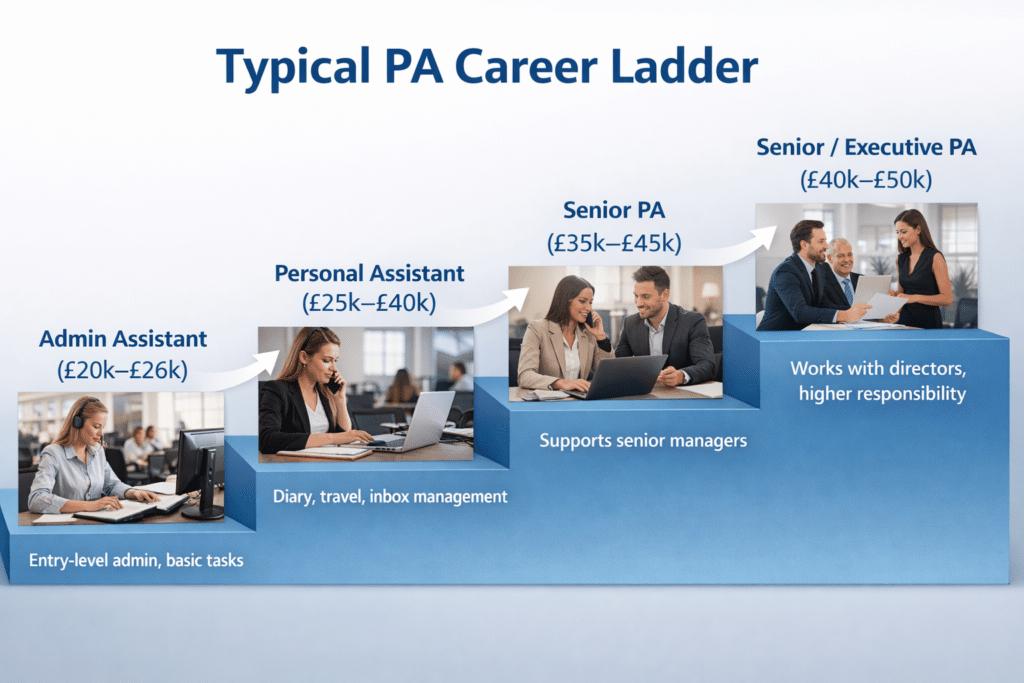
The PA route is structured and steady. It often starts with core admin tasks and builds into trusted support.
Typical PA Career Ladder
- Admin Assistant (£20k–£26k)
Entry-level admin, basic tasks - Personal Assistant (£25k–£40k)
Diary, travel, inbox management - Senior PA (£35k–£45k)
Supports senior managers, more autonomy - Senior/Executive PA (£40k–£50k)
Works with directors, with higher responsibility
Strengths of the PA Path
- Clear entry point
- Stable progression
- Strong demand across industries
Limitations
- Salary ceiling is lower than that of EA roles
- Less strategic involvement
- Progression can plateau without upskilling
EA Career Progression Path
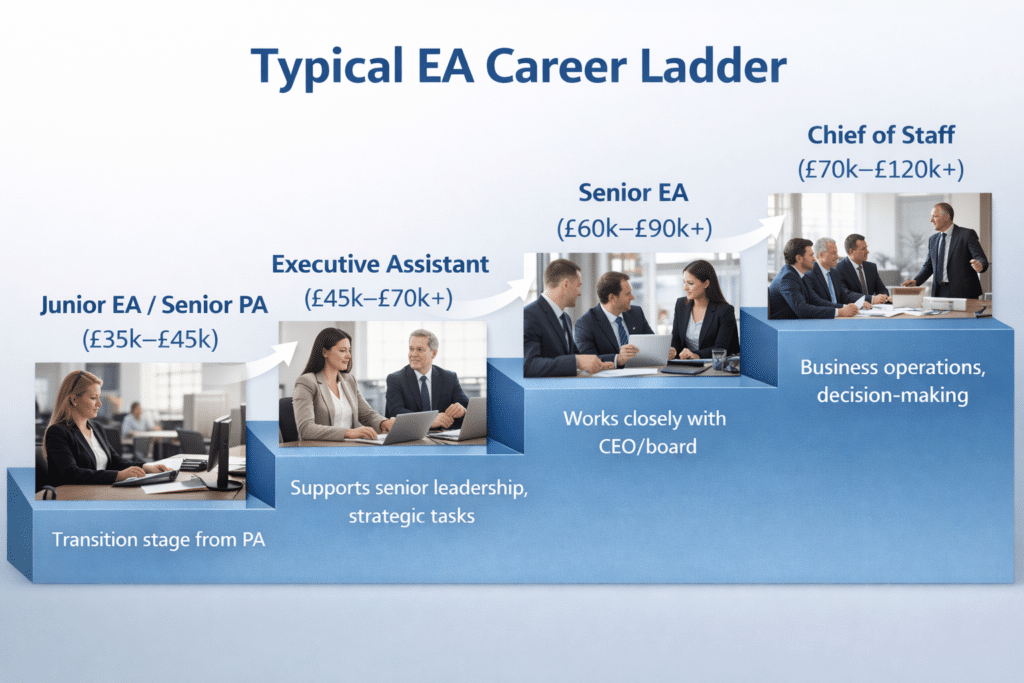
The EA path is faster and more strategic. It moves beyond admin into business influence.
Typical EA Career Ladder
- Junior EA / Senior PA (£35k–£45k)
Transition stage from PA - Executive Assistant (£45k–£70k+)
Supports senior leadership, strategic tasks - Senior EA (£60k–£90k+)
Works closely with the CEO/board - Chief of Staff (£70k–£120k+)
Business operations, decision-making
Strengths of the EA Path
- Higher earning potential
- Strategic exposure
- Faster progression
Limitations
- Higher expectations
- Requires strong business awareness
- Competitive roles
Key Differences in Career Growth
| Factor | PA | EA |
|---|---|---|
| Entry level | Easy | Requires experience |
| Progression speed | Moderate | Faster |
| Salary ceiling | ~£50k | £100k+ |
| Strategic involvement | Low–Medium | High |
| Leadership exposure | Limited | Direct |
Key takeaway:
PA is a solid starting point. EA is where long-term growth accelerates.
How to Move from PA to EA
This is the most common and effective route.
Steps to Progress
- Expand your responsibilities
- Take on project work
- Support senior stakeholders
- Develop business awareness
- Understand company goals
- Learn financial basics
- Strengthen communication
- Work with senior leaders
- Build confidence in meetings
- Gain formal training
- EA-specific skills will accelerate your promotion propects.
Skills That Drive Faster Progression
To move beyond the PA level, focus on:
Core Skills
- Advanced diary and inbox management
- Stakeholder communication
- Problem-solving
EA-Level Skills
- Strategic thinking
- Project coordination
- Decision support
- Confidential handling of business matters
Leadership Skills
- Influencing without authority
- Managing priorities across teams
- Supporting executive decisions
Common Mistakes That Slow Career Growth
- Staying in pure admin tasks too long
- Not asking for higher-level responsibilities
- Avoiding senior stakeholder interaction
- Not investing in training
- Undervaluing your role
Realistic Career Comparison
- A PA can build a strong, stable career
- An EA can move into leadership-level influence
If your goal is:
- Stability → PA path works
- Growth, salary, influence → EA path is stronger
FAQ
Is EA progression faster than PA?
Yes. EA roles involve higher responsibility, so progression and salary increases tend to happen faster.
Can a PA become an EA?
Yes. Most EAs start as PAs. The transition depends on skills, exposure, and experience.
Do EAs earn more than PAs in the UK?
Yes. EAs commonly earn £45k–£70k+, while most PAs top out around £40k–£50k.
Is the EA role harder than PA?
It’s more demanding. It requires strategic thinking, decision-making, and working closely with senior leadership.
Do you need qualifications to become an EA?
Not always, but structured training can speed up progression and improve job prospects.
Final Thoughts
When looking at EA vs PA career progression, the difference comes down to how far you want to go.
- PA roles build strong foundations in the organisation and support
- EA roles move into influence, strategy, and decision support
Both paths are valid. But they lead to different outcomes.
If you stay at the PA level, you can build a stable and respected career.
If you step into EA-level responsibilities, you open the door to higher salaries, closer access to leadership, and long-term progression into roles like Senior EA or Chief of Staff.
The shift is less about job title and more about mindset. Moving from task-based support to business support is what changes your trajectory.
Ready to Progress?
If you’re serious about moving forward, don’t leave progression to chance.
Start by:
- Taking on higher-level responsibilities where possible
- Positioning yourself as more than just admin support
- Actively building EA-level skills
To accelerate this, structured training gives you a clear route.
👉 If you’re still early in your career, explore the Personal Assistant Diploma to build a strong foundation.
👉 If you’re ready to step up, the Executive Assistant Diploma is designed to move you into higher-level roles faster.
Both options are built to help you progress; the key is choosing the level that matches where you are now. The next logical step is to build EA-level capability and position yourself for higher-responsibility roles.